HRG helps water utilities enhance efficiency, reliability, and sustainability.  We offer a full range of infrastructure solutions from planning through engineering, permitting, and construction alongside complementary expertise in utility finance, funding strategies, operations, and management.

As an approved Bentley platform partner, we help utilities implement a digital twin using Bentley’s OpenFlows WaterSight solution. Our approach goes beyond software implementation to truly incorporate data into a utility’s operational decision-making. Working closely with utility staff, we assist at every stage: mapping existing data sources, configuring OpenFlows WaterSight to accurately reflect network conditions, and turning data into actionable strategies.

THE VALUE OF PROCURING DIGITAL TWIN IMPLEMENTATION SERVICES

Digital twins can be a powerful tool for small water utilities, but proper configuration is crucial to ensure the software provides the value operators and decision-makers need.

The value a water utility gets from a digital twin depends on more than the technology. It also depends on proper execution. Working with an experienced implementation partner allows small utilities to move faster, reduce risk, and ensure their digital twin investment delivers real operational and financial benefits.  Here’s why:

Dedicated time & capacity
Most small water utilities have a small team consumed by day-to-day operations.  They don’t have a lot of time to dedicate to digital twin implementation, and configuration can be labor-intensive.

Specialized expertise
Digital twin implementation requires expertise in SCADA, GIS, data calibration, workflows, and cybersecurity. Data may need to be cleaned and structured before it can be integrated reliably.  Expertise in hydraulic modeling may also be required as small utilities evolve their twin toward more sophisticated uses like predictive analysis and risk management. Connecting platforms, sensors, and enterprise systems can introduce new pathways into a utility’s technology environment.  Digital twin architecture should be designed with cybersecurity in mind at the start to prevent unintentionally exposing your systems, granting excessive access, or creating vulnerabilities that didn’t exist before. Small utilities may not have all of these skills in-house, but a good digital twin implementation partner does.

Reduced risk and right-sized investment
An experienced implementation partner can apply proven methodologies and lessons learned from other utilities to navigate common challenges (like underestimating the labor involved in finding, reconciling, cleaning, and validating data; failing to fully scope the costs of cloud infrastructure, software licenses, sensors, integration and vendor coordination; or creating an overly complex system that is impractical for utility staff to use.)

A good implementation partner knows how to scale a system over time, focusing on high-impact uses up front and expanding in phases to make sure utilities don’t overinvest in unnecessary complexity before demonstrating real value.

Choosing a Digital Twin Implementation Partner

The right partner understands water system operations and is focused on helping you build long-term operational capability (not just installing software).

Deep water sector expertise

Your implementation partner should ideally have proven experience in the design and operation of water system infrastructure (distribution, collection, and treatment).  They should understand hydraulics and water quality, know the regulatory constraints, and be familiar with utility workflows related to capital planning, operations and maintenance, and emergency response. 

HRG has been serving water and wastewater utilities since the firm was founded in 1962.  We assist with all phases of planning, design, permitting, and construction of treatment plants as well as collection and distribution systems.  We also provide comprehensive guidance related to utility finance, management, and operations, focusing specifically on small and mid-size utilities serving less than 50,000 customers. (Learn more about our water and wastewater services. View a sample of our water and wastewater projects.) We have a reputation for quality and dozens of awards for our projects and people at the state and national level.

The ability to integrate related technologies

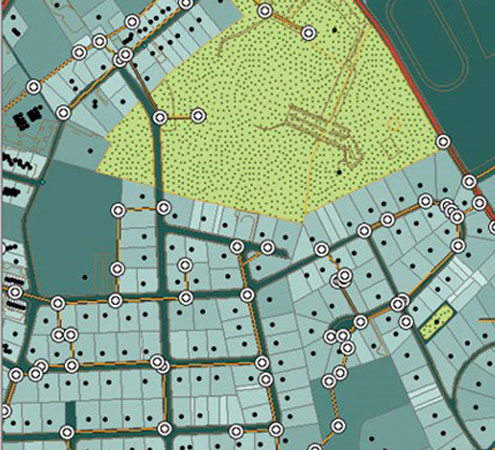
A digital twin connects data from many different systems: SCADA, GIS, hydraulic models, meters, and sensors, etc. The SCADA system provides real-time data on water supply and transmission, monitoring pressure, flow, and pump speed.  Meters and sensors provide real-time data on user demand.  GIS gives all of this data spatial context, showing you exactly where activity is occurring.   Optionally, a hydraulic model introduces predictive capabilities by simulating the physics of water movement under changing conditions.  Your partner should be familiar with the design and operation of all these technologies so that they are able to work with vendors to properly integrate them. Without proper vendor coordination, implementation schedules can slip, and accountability may blur.

HRG has been designing SCADA systems, GIS, and hydraulic models for water utilities for decades, and we have extensive experience coordinating with vendors on installation and integration.

Knowledge of data strategy, governance, & cybersecurity

You want a partner that can assess your data readiness honestly and realistically; who can help with data cleaning and validation; set up project governance, security, and access protocols; and understand related regulatory requirements.

HRG’s approach begins with a detailed data readiness assessment. We have real-world experience cleaning and validating data for water system digital twin implementation, and our chief innovation and technology officer has proven expertise in cybersecurity and risk management, helping organizations develop controls to protect assets, comply with regulatory requirements, and train staff to recognize and respond to threats.

A focus on measurable outcomes & ROI

Small utilities have tight budgets and are accountable to their ratepayers.  They need to be able to demonstrate real value from an investment in digital twin technology.

HRG works closely with our clients to understand their true operational needs and pain points, so that we can design a system that provides immediate value.

We can customize your system to reduce non-revenue water, improve resilience, reduce energy and chemical costs, and/or plan capital spending.

A scalable approach

Small utilities need flexibility to start small and expand later, as budget and staff capabilities allow.

HRG can phase the design of your system to match your resources and needs.  We can build the functionality you need today with a solid foundation to facilitate future uses. As we help you scope your project, we will be able to clearly define the types of decisions your digital twin will help you make now and provide a roadmap to future use cases based on your needs.

Long-term commitment to adoption & performance

Digital twins are a long-term commitment, not a short-term project. You need a partner that is going to stick around, who wants to ensure you reap value from the system for years to come. Your implementation partner should be able to support training and internal capacity building.  They should also be able to help you analyze the data, make decisions, and take action that enhances service and efficiency.

HRG thinks well beyond the go-live data for your digital twin.  We get to know your whole team closely and work with them to design a system aligned to how they will use it every day.  As we prepare to launch the digital twin, we provide customized training to your staff.  After go-live, we offer three tiers of long-term support, depending on your needs. The foundational plan includes monthly dashboard reviews and data quality checks, high level reporting, and issue resolution.  A middle tier guides you toward deeper adoption and integration, and the innovation tier shepherds you toward fully leveraging all platform capabilities with early access to emerging features.  Our comprehensive expertise in planning, design, operations, finance, and utility management makes us an ideal partner for the long-term, helping you maximize the value of your digital twin on a daily basis.

Are you interested in exploring how a digital twin could help your water utility?

Many small utilities think a digital twin is out of reach for a system their size, but every utility – regardless of size, budget, or existing technology – can start taking steps toward more informed decision-making right now.

Learn practical steps your utility can take to establish the foundations of data-driven decision-making (link opens in new window)
Read our article The Authority, a magazine published by the Pennsylvania Municipal Authorities Association

See our scalable framework for building digital twin capability incrementally (link opens in new window)
Read our article in Wastewater Digest, a national publication covering technology and trends in the municipal wastewater industry.

Contact Melissa Rohland to discuss your operational challenges and learn about our data readiness assessment