
HRG Moves Up 29 Spots on ENR’s Top 500 Design Firms List
 Herbert, Rowland & Grubic, Inc. (HRG) is listed at number 406 in a national ranking of the top revenue-producing design firms published this month by Engineering News-Record magazine. The firm increased its ranking significantly thanks to strong sales and sound financial management.
In 2019, HRG’s revenue grew 17%, continuing a trend of consistent growth over the past five years. Company president Jason Fralick attributes the firm’s success to its strong ESOP culture and a loyal base of clients who trust HRG with expanding opportunity year-after-year.
“Our business is about people: the people on our team and the communities we serve. Our employee-owners have a shared stake in the company’s growth, and they continually enhance quality, productivity and innovation for our joint benefit and the benefit of our clients. We would not be able to sustain the growth we’ve experienced without the trust of our clients, and we wouldn’t have that trust without the dedication of our team.”
-Jason Fralick, HRG president
Engineering News-Record (ENR) is a leading trade journal for architects, engineers, and contractors. It compiles its Top 500 Design Firms list annually based on the revenue that firms earned in the preceding year.
ABOUT HRG
Herbert, Rowland & Grubic, Inc. (HRG) is a nationally ranked design firm providing civil engineering, surveying, and environmental services to public and private sector clients throughout Pennsylvania, Ohio and West Virginia. The firm was founded in Harrisburg in 1962 and has grown to employ more than 200 people across the tri-state region. For more information, please visit the website at www.hrg-inc.com.
SOPs
This page is redirecting you to:
WEBINAR: How to Cut Stormwater Costs with Partnerships & Collaboration
Communities report increased flooding in recent years – even outside the flood zone.
Aging infrastructure is at or near the end of its useful life, and signs of failure are appearing.
Regulatory agencies are requiring communities to do more to manage stormwater, but additional funding is not being provided.
These are big problems, and most communities can’t solve them alone. Collaboration is the key to keeping the cost of stormwater improvements manageable, and this webinar will show you how to make collaboration work for your community.
Our financial services practice area leader Adrienne Vicari joined Jim Cosgrove of Kleinfelder, Inc. and the New Jersey League of Conservation Voters to discuss the benefits of collaboration and offer tips communities can use to form effective partnerships. She identifies specific entities for partnership (including other municipalities, state and federal agencies, property owners, and a variety of non-profit organizations) and shows real world examples of how partnerships are saving municipalities millions of dollars on stormwater management and MS4 compliance.
Watch this free webinar below and contact Adrienne Vicari to discuss partnership opportunities for your community.
Reduce the Cost of MS4 Compliance and Pollutant Reduction Plans Through Cooperation
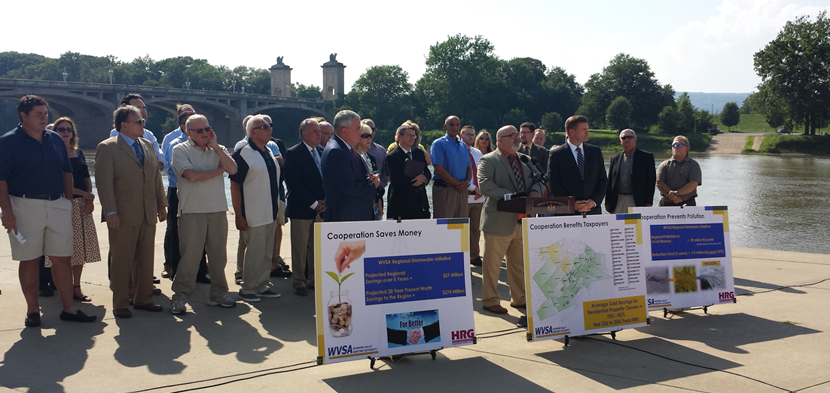
Stormwater management has become a major priority for environmental agencies over the past decade, and communities are struggling to meet the increasing requirements to reduce stormwater pollutants and runoff volume. The cost is simply too high for many municipalities to bear alone, but it becomes much more manageable if municipalities can share the burden with their neighbors.
Take the Pollutant Reduction Plan requirement of the MS4 application as an example. If a municipality submits a Pollutant Reduction Plan on its own, it is limited to constructing BMPs within its own borders or the drainage way of its impaired streams, but DEP will generally accept the construction of BMPs anywhere within the watershed for an MS4 permit that is submitted by a regional cooperative. This means cooperating municipalities can install BMPs that yield the greatest pollutant load reduction for the lowest cost.
Usually the largest expense associated with BMP construction is the cost of acquiring land on which to build the BMP. An individual municipality may not have much land on which to build, particularly if it is an urban municipality in which most of the available land has already been developed. As a result, the municipality may be forced to implement a large number of BMPs that each provide only marginal individual benefit in order to meet the pollutant reduction goal. If a municipality submits a regional plan with other communities in the same watershed, it will have access to a much greater land area on which to build BMPs and a reduced need for right-of-way acquisition and easements. This allows the participating municipalities to build the most effective water quality measures in the places with the greatest need.
Any improvements in upstream water quality will lead to improvements in downstream water quality, so a municipality can still see improvements in its water quality using a watershed-based approach even if a particular BMP is not located within that municipality’s borders.
When BMPs are constructed on a watershed-wide basis, the construction cost is typically lower due to economies of scale, and the water quality results are better.
Herbert, Rowland & Grubic, Inc. (HRG) is working with the Wyoming Valley Sanitary Authority on a regional stormwater collaboration that includes 32 municipalities in Luzerne County. These municipalities intend to meet 70% of their sediment reduction goal with a single BMP: conversion of existing flood control levees into a constructed wetland with a sediment forebay and a meandering stream channel.
 Learn more about our work with the Wyoming Valley Sanitary Authority in this 3-part series published in The Authority, a magazine published by the Pennsylvania Municipal Authorities Association.
Regional cooperation can save municipalities money in other ways besides BMP construction. For example, the cost of preparing the Pollutant Reduction Plan itself will be much lower as a result of cooperation due to economies of scale.
Hiring a consultant to assist with pollutant reduction planning can cost thousands of dollars. If that cost is shared with 10 other municipalities, each individual municipality only has to pay a small portion.
It’s like sharing your first apartment with two roommates when you were in your 20s. The fixed cost of rent and utilities is the same whether one person lives there or three, but each person pays less if they can split that cost three ways (instead of renting their own individual apartments).
Stormwater management involves many fixed costs like the cost of owning equipment to clean out inlets or conduct outfall inspections.
Spreading those costs across a greater number of users means each user pays a smaller price for service.
Another way cooperation can reduce the cost of stormwater management is by giving municipalities increased purchasing power. Generally, you can negotiate lower unit costs for items when you buy them in larger quantities. For example, cooperating municipalities could replace or slip line several miles of pipe for a lower cost if the work was completed as part of a larger, regional project. These savings apply to the bidding of services, too. The municipalities working with the Wyoming Valley Sanitary Authority saved hundreds of thousands of dollars on base mapping (i.e. orthophotography, impervious area, etc.) by participating with WVSA under a single project (rather than having each municipality bid its own contract).
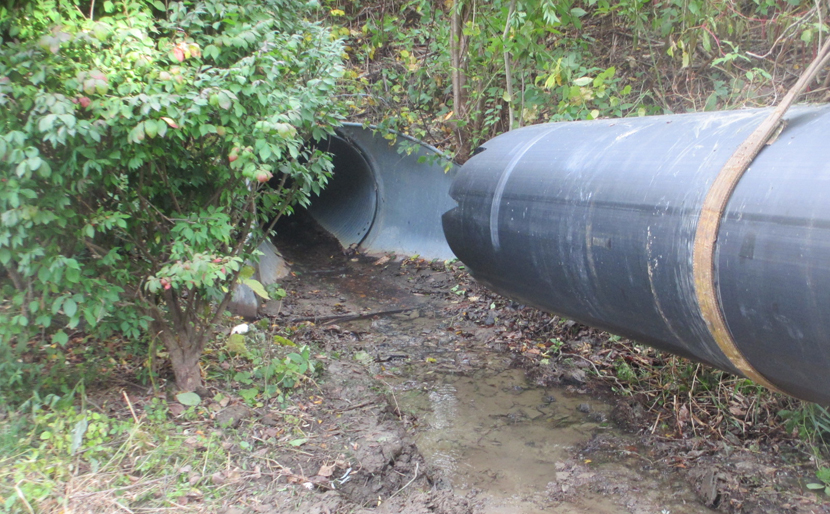
Municipalities have greater purchasing power when they cooperate on stormwater management solutions. For example, cooperating municipalities could slip line several miles of pipe for a lower cost if the work was completed as part of a larger, regional project.
A regional cooperative also has more borrowing power than a single municipality, and funding agencies are more likely to award a grant or loan to a regional project than one submitted by a single municipality. Funding agencies prefer regional projects because they believe regional cooperation streamlines costs, and politicians tend to support projects that benefit as large a constituent base as possible. A regional initiative should be tied together by legal agreements that assure the funding agency all funding will be properly administered. (These legal agreements are also required to meet DEP requirements for submission of a regional pollution reduction plan.)
This post is an excerpt from a longer article in the July-August-September issue of Keystone Water Quality Manager magazine. The article is focused on the cost savings communities enjoy by cooperating with regional partners on their stormwater management programs. Read the magazine for advice on finding partners for your stormwater management program or contact us to request a copy.


Erin G. Letavic, P.E., is the regional manager of civil engineering services in HRG’s Harrisburg office. She guides municipalities and cooperative groups throughout Pennsylvania through the management of their MS4 permits, provides grant application development and administration services, and provides retained engineering services to local government.

Adrienne Vicari, P.E. is the financial services practice area leader at Herbert, Rowland & Grubic, Inc. (HRG). She provides strategic financial planning and grant administration services to numerous municipal and municipal authority clients. She also serves as project manager for several projects involving the creation of stormwater authorities or the addition of stormwater to the charter of existing authorities throughout Pennsylvania.
Regional Stormwater Plan to Save Taxpayers Money in Luzerne County
This article is an excerpt from the December 2017 issue of The Authority, a magazine produced by the Pennsylvania Municipal Authorities Association (PMAA). It is the second in a series of 3 articles about an innovative approach to stormwater management and MS4 compliance being pioneered by 31 municipalities and the Wyoming Valley Sanitary Authority. You can read the first article here: How Municipalities in the Wyoming Valley Are Cutting Stormwater Costs by Up to 90% )

Thirty-one municipalities in Luzerne County are piloting a regional approach to MS4 compliance that may revolutionize the way Pennsylvania responds to the growing challenges posed by stormwater.
They have signed cooperative agreements with the Wyoming Valley Sanitary Authority, which will serve as MS4 permit coordinator for the entire region. In our previous post, we discussed the many ways a regional partnership can lower the cost of stormwater management for municipalities.
In this post, we’ll discuss how:
Cooperation benefits the taxpayer.
If regional cooperation lowers the cost of stormwater management, it stands to reason those cost savings will be passed on to the taxpayer. But, make no mistake, replacing aging infrastructure and constructing Best Management Practices will cost money, and that money will have to come from somewhere.
With municipal budgets already stretched to the limit, communities may have to consider new revenue sources. That could mean a tax increase or a stormwater fee.
Stormwater fees are generally a better deal for the average constituent. This is because a fee structure ensures everyone pays their fair share.
If taxes were raised to cover the cost of stormwater management, many property owners with large amounts of impervious area would be exempt: hospitals, schools, and other non-profit institutions. However, these institutions can sometimes be the biggest contributors to a community’s stormwater issues because stormwater runoff occurs when the water runs along impervious surfaces and cannot infiltrate the ground.
If stormwater management is paid for through a property tax increase, these non-profit organizations won’t pay for the services they’re using, but someone will have to, and that burden will fall on homeowners and small businesses.
Studies show time and again that the average homeowner would pay less for stormwater management if he or she were charged a stormwater fee than if the municipality raised property taxes.
The regional cooperation being pioneered by the Wyoming Valley Sanitary Authority is an especially good deal for local taxpayers: Our analysis showed that the average residential property owner will save 70 – 93% by paying a regional stormwater fee instead of paying an increased property tax.
The Wyoming Valley Sanitary Authority’s estimated stormwater fee is between $3.00 and $4.50 per month. This is lower than the other stormwater fees currently being paid throughout Pennsylvania, which average between $6.50 and $8.50 per month.
By using a regional approach, WVSA is able to lower costs beyond what an individual municipal authority could likely achieve. These numbers are even more impressive when you consider that the fees for most of the other municipal authorities included in the average above were calculated before taking 2018 MS4 permit requirements into account. Therefore, those communities may actually have to raise fees higher to meet the stricter requirements coming in the next permit cycle. WVSA’s estimated cost already accounts for the 2018 permit requirements.
Municipal leaders are stewards of the public’s money, but they are also stewards of the environment. In our next post, we’ll discuss how regional cooperation on stormwater management can more effectively keep our rivers and streams clean for drinking, agriculture, and recreation.
Jim Tomaine has more than 30 years of engineering experience. He holds a bachelor’s degree in civil engineering from The Pennsylvania State University and a master’s degree in business administration from Wilkes University. He is the executive director of the Wyoming Valley Sanitary Authority and has been at WVSA for twenty seven years. Prior to the WVSA, Mr. Tomaine worked in the private sector as a design engineer. He currently holds his A-1 Wastewater Treatment Plant Operators Certification in Pennsylvania and is also a registered professional engineer.
Adrienne Vicari is the financial services practice area leader at Herbert, Rowland & Grubic, Inc. (HRG). In this role, she has helped the firm provide strategic financial planning and grant administration services to numerous municipal and municipal authority clients. She is also serving as project manager for several projects involving the creation of stormwater authorities or the addition of stormwater to the charter of existing authorities throughout Pennsylvania.